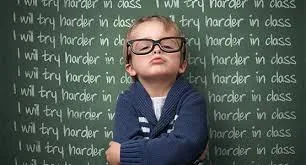
Student Misbehavior
Student Misbehavior
I’ve mentioned this many, many times – the way to connect with students is by building relationships. After all, if a student can relate to you, their teacher, about anything, they will likely “buy” what you’re selling - whether it’s a lesson or if it’s a conversation about behavior. Building relationships in the classroom leads to mutual respect, and because of this, teachers and students build trust.
Trust is everything when you’re a teacher. If you don’t have it with your students and their parents, whatever you’re trying to teach them may not stand. Now, some will say that you can still learn if you disassociate from the person delivering the lesson and just take the lesson at face value, and that can happen, but it may not lead to learning beyond the classroom – what some teachers and curriculum specialists call the “what if” stages of instruction. But as far as behavior goes, trust is vital.
Classroom management is a forever process in teaching. What works for one may not work for another. And if you’re looking at a classroom of 25 students, establishing rules is important, but there will be gray areas - especially if there are students who have a behavioral disability – and that’s usually based on some kind of trauma.
Gone are the days of corporal punishment where teachers could rap a student’s knuckles with a ruler or cuff them upside the head - all of which I've seen growing up in the public school system. And my friends in parochial school – I’ve heard stories about the nuns and their “ways” of dealing with misbehavior.

Like all things, when you understand brain development, you know that if the amygdala is in a state of fight, flight, or freeze response, there has to be a way to address the behavior. Humiliation, yelling, sarcasm or even ignoring the behavior is not going to work. What then will work?
There are ways to address behavior – the very first that I use as a teacher is proximity. I don’t say anything, I just walk near to where the behavior is happening and continue with the lesson. Or if someone is talking or trying to gain the attention of other students, I’ll simply stop talking and stare in the direction of the student. That usually works at the beginning. If a pattern develops with the behavior, then I would ask the student to either step outside for a minute or stay after class for a minute to talk about what was going on. Like all conflict resolutions – using the “I” statements “I feel, I need, I’d like” with the student helps start the conversation. Then it alternates to the student – what do they need, feel, or like that they’re not getting? The conversation continues until there are steps moving forward. I also like to end the conversation with this caveat, “What do you think should happen if you do this behavior again?” It puts the oneness on the student. And then if necessary, I follow through.
What I do and have done, is not perfect. And sometimes it goes haywire – sometimes the student is so angry that rational conversation cannot happen. Then what? If it’s something that happens in the middle of the class and lesson, I have to remove the student by sending a message to an administrator to come to my room for a “pick up.” Back in the day, prior to instant messaging, a phone call might be made to the office. The bottom line is that instruction cannot continue if someone is having a meltdown.
The situations that I’ve experienced have been either at the middle or high school. I know that elementary age children sometimes are still figuring out their emotions and how to deal with them, so there might be other methods of classroom disruptions, but I can only speak to what I’ve used and what has worked for me. And again, what works for one student may not work for another. Which is why building trust and mutual respect is important.
As a first year teacher, I was trying my best to get a handle on all things procedural, instructional, behavioral. And I wasn’t good at any of it. Well, I tried, but I was learning just as much as the kids, and I faked it till I made it. But you know what else I did? I asked others for support. I talked to other teachers. I talked with my principal. I used all the “tools” to try to figure it out. I called parents, met with counselors, school psychologists – anyone who could help me figure out what it was that would help that one kid. I was not ashamed that I didn’t know. And honestly, even at the end of my teaching career, I didn’t have all the answers, and some kids just challenged me a little differently.
There is much to be said about the repercussions of the pandemic on our students, and because this type of situation has never happened before, we are all learning from the anxiety that has been in its wake. Anxiety not just from the pandemic in the older children, but the idea that kids have had “screens” in front of them since their early years. A book entitled, The Anxious Generation by Jonathan Haidt, goes into great detail about what we, as a society, have done to our kids.

And because of this, we’re seeing the repercussions in our classrooms, as well as into the workforce. There’s much to learn yet about this behavior.
Teachers are sometimes put in precarious situations and sometimes the behavior is violent - whether it's toward the teacher or toward another student. That is not tolerable, nor should it be. We have done much to try to keep kids safe, but safety needs to be a priority for our teachers as well. This is a topic for a later post.
Discipline in our public schools is an ongoing topic, and with reward programs in place it sometimes gets lost in the mix. Outdated programs like PBIS (Positive Behavioral Interventions and Supports) focus on rewarding positive behaviors rather than actual discipline. And honestly, the fear of lawsuits in our schools have fostered the "talk to the kid," and send them back to class without a consequence is far too familiar across the country. Something has to be done. Public schools don't have enough resources available to them. PERIOD. END OF STORY. Another reason why we have to VOTE for candidates who want to provide for our public schools -- our public students. It will all lead to a more CIVIL society. The behavior correction should mimic what society has in place with its laws and enforcement.
We're at a breaking point, friends. A civil society is at stake. Let's teach and enforce proper behaviors to help change what we're seeing in the world today. Violence begets violence and if there aren't just punishments, society will crumble. We need to do better.


